

By Ryan J Nims
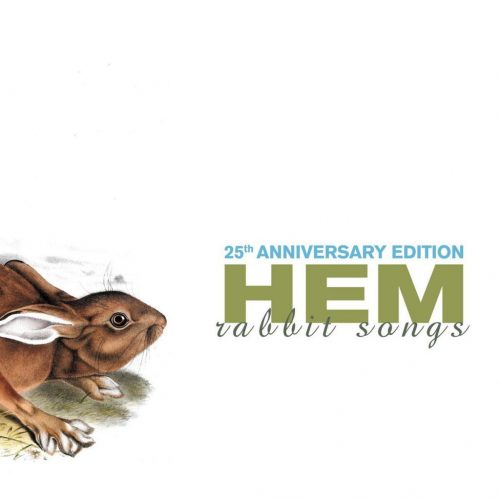
Sadly, I don’t remember how I discovered Hem’s debut Rabbit Songs (Waveland, 2000). I’m pretty sure it was while I was on a work trip to Los Angeles in January of 2002, as the album has always reminded me of that time. Regardless of my hazy memory of the album’s discovery, the way Rabbit Songs makes me feel has never changed. It’s one of my favorite albums; one that I have returned to numerous times over the years. The blend of old-time music, Americana, parlor music, and even classical gives a feeling of timeless nostalgia. The album turns 25 this year and Hem are celebrating by releasing the album for the first time on vinyl on November 28th via their own label, Waveland Records.
Hem was started in Brooklyn, NY by Daniel Messé (piano, celeste, glockenspiel, etc), Gary Maurer (guitar, mandolin, etc), and Steve Curtis (guitar, banjo, mandolin, harmony vocals). After an initial search for a vocalist proved unproductive, the band eventually received a cassette tape of a capella lullabies that Sally Ellyson had recorded for a friend’s child. Never having sung professionally, she joined the band, and the core lineup was cemented. Other frequent collaborators include Catherine Popper & George Rush on upright bass, drummer Mark Brotter, Bob Hoffnar on pedal steel, Heather Zimmerman on violin, and Dawn Landes on harmony vocals.
The band recorded at Stratosphere Sound (a studio started by James Iha of the Smashing Pumpkins and Ivy’s Adam Schlesinger & Andy Chase) to lay down the tracks for their debut album. Rabbit Songs was then self-released, before being reissued at different times by labels such as Bar/None, Dreamworks, and Rounder Records.
In July of 2002, the album was featured on NPR’s All Songs Considered, and the next day, Rabbit Songs hit number 1 on Amazon.
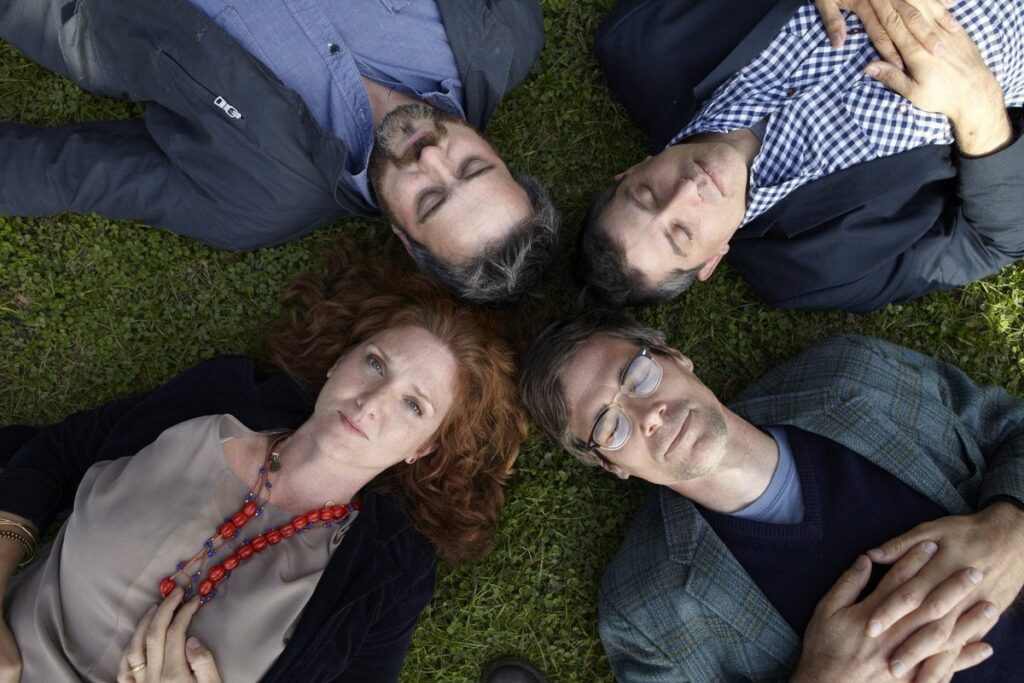
(Hem, clockwise: Sally Ellyson, Gary Maurer, Dan Messé & Steve Curtis. Photo credit: Anna Williams)
Rabbit Songs opens with one of the lullabies off of Sally’s cassette, “Lord Blow the Moon Out Please,” the first of a few of the demos that would appear on a Hem album.
This leads into “When I Was Drinking,” a song about coming out of a relationship seemingly based around alcohol.
“Half Acre” is arguably Hem’s best known song, thanks in part to its use in a Liberty Mutual commercial in the mid-oughts. Dan Messé recently revealed that after some experimentation, the glockenspiel sound was created by using AA batteries instead of mallets. The band released the remastered single along with the announcement of the record:
“Burying Song” is the first of a few instrumental tracks, featuring piano and orchestra.
Next is “Betting on Trains” which features some haunting pedal steel. Narritively, the song brings to mind a horse race, with trains being the objects racing.
“Leave Me Here” is another stand-out track, a solemn song with some of Ellyson’s most intense and heartbreaking vocals. The song seems to equate love with Heaven, and by contrast, loneliness with Hell. This song had originally been performed by a band called Big Iron Skillet that Messé was previously a member of.
The narrator of “All that I’m Good For” is apparently someone with a checkered past, whose significant other’s love makes her a better person.
“Idle (the Rabbit Song),” while having nothing to do with rabbits, instead follows a couple idly spending time together.
“Stupid Mouth Shut” is about that feeling of wanting to tell someone how you feel about them, but being too afraid to say it.
“Lazy Eye” is a piano and fiddle-driven song, which sounds like it could be performed in a 19th century parlor. Lyrically, it speaks of memories of a love that is no longer there. The song was initially called “Hem” but the title became the band’s name instead.
Another incredible track is “Sailor” which features a gorgeous French Horn performing the second verse. Sally’s vocals and the sparse instrumentation add to the feeling of longing for a loved one. The band released the remastered version as the second single.
“Polly’s Dress” is another short instrumental.
“Night Like a River” is a shuffling folk track, featuring some nice vocal harmonies between Ellyson and Curtis, a dynamic that will feature more prominently on later albums.
“The Cuckoo” is a bluegrass adaptation of a traditional English folk song (Roud Folk Song Index #413).
The final instrumental track, “Waltz” is another piano and fiddle based song.
The original album closes with “Horsey,” an old timey country track with some beautiful harmonies. Messé has said in past interviews that he wanted a song called “Horsey” because it was the antithesis of what was considered “cool” around the turn of the millennium.
The remaster also includes “St. Charlene,” a song originally included on a split EP with the Autumn Defense called Birds, Beasts, & Flowers (Arena Rock, 2004).
I reached out to Dan Messé to talk a little more about the upcoming anniversary release:
How does it feel to have this 25th Anniversary remaster of Rabbit Songs ready for release?
It doesn’t feel possible that it’s been 25 years already. When we started this project, we were all basically still kids. Then for a while we were grown with kids of our own. Now, the kids are leaving the nest and we are…old? Time seems to telescope in both directions these days; it feels like it was just yesterday when we were meeting up for our first rehearsals, but then so much has happened in between then and now, it may as well have been centuries ago.
When did you, Gary and Steve originally start the Hem project, and was it always envisioned as a folk group?
Believe it or not, it started as a trip hop project! At least that was the first project that Gary, Steve, and I all worked on together. After that, we tried a version of Rabbit Songs with me singing lead, with more conventional singer-songwriter-y arrangements. I think we just really enjoyed working together, and we knew there was something there worth developing.
Sally’s beautiful lullaby demos have featured on a few Hem albums, can you speak to why the band chose to include them?
Our music is all about time and place. In the case of Rabbit Songs, that time and place was very much defined by that homemade tape of Sally’s lullabies. I played that tape to shreds in my Walkman (yes it was that long ago), and all of Brooklyn was colored by what I heard.
What does Hem’s writing process look like?
I tend to write “title first”. I have a long list of song titles that I keep adding to – most of these, I have no idea what they even mean, or what sort of song they could possibly represent. I just have a sense that a title will become a song at some point in the future. Then musically, I always have a recorder going when I’m sketching ideas. Sometimes I’ll be listening back to these sketches and one will pop out and attach itself to one of the outstanding titles. From there, the writing process can be arduous or easy, depending on who-knows-what. And of course, once a song gets introduced to the band, it sort of grows up from there. Tall Steve Curtis has his own writing process of course, but in the end, all Hem songs are very much a venn diagram of the four of us.
What is the origin of the title Rabbit Songs?
I was living on Warren Street in Brooklyn when we made our first album, so it seemed only natural to call the album Rabbit Songs. I also think rabbits really captured the essence of what we were trying to do; rabbits are often depicted in children’s stories and art as these innocent, playful, fluff balls. At the same time, rabbits are these hunted creatures, always on guard and full of fear. I guess I relate to this duality. (Ed. A “warren” is a series of underground burrows built by rabbits.)
What was the process of remastering Rabbit Songs like?
Going back to the original Rabbit Songs mix tapes was a joy, but sort of a haunted joy, not unlike exploring a house you lived in as a child; finding old rooms you used to play in, places you forgot you remembered until you were standing back in that space.
You’ve recently mentioned getting the best glockenspiel sound by using AA batteries as mallets. Were there other experimental approaches to get the right sounds in recording Rabbit Songs?
Part of the magic of those Rabbit Songs recording sessions was in not knowing what we were doing. Everything was an experiment back then, so everything was new for us. Sally had never even been in a professional studio before, which might be the craziest fact of all given her extraordinary voice. We knew what we were doing was something special, and it just felt like there were angels in the room with us.
Now that Rabbit Songs has a vinyl release, are there any plans to reissue other albums?
The plan is to do the same for all our albums. Eveningland is next!
Can you talk a little about what we might be hearing next from Hem?
We’ve started recording a new collection of songs. I think it’s some of our best work, though the release date may not be for a while yet. We’ve never been the most prolific band in terms of releasing new material, and that is holding true for us today. We are meticulous in our own homemade, crafty way, and we have a very specific vision we want to capture.
Since Rabbit Songs, Hem has recorded five more albums: Eveningland (Rounder, 2003), No Word from Tom (Nettwerk, 2006), Funnel Cloud (Nettwerk, 2006), a soundtrack to Shakespeare’s Twelfth Night (Nettwerk, 2009) that was produced for Shakespeare in the Park in the summer of 2009, and finally Departure and Farewell (Nettwerk, 2013). They have also released a handful of EPs and compilation appearances.
If you’ve never heard Hem, this is a great place to start, especially if you are into Americana, folk music, or even dreampop. Fans of Folkville (every other Tuesday, 7:00 pm – 8:00 pm) will surely find something to like in this collection of songs.