

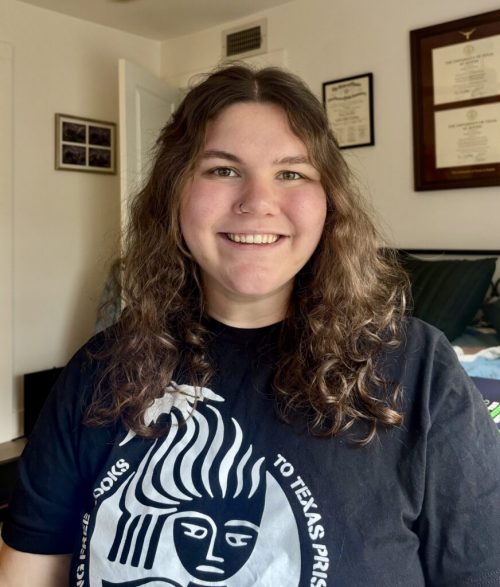
KOOP Radio wraps up its month-long celebration of World Literacy Day as KOOP Community Council member Nora Redfern sat down for a conversation with Raegan Bass who is with KOOP nonprofit partner Inside Books Project, an Austin organization that sends donated free books and reading materials to people incarcerated in Texas. Volunteers read letters with book requests from people incarcerated, search for books to fulfill the request, and write an encouraging letter back that is included in the package of books sent to the person who is incarcerated.
NR: Hi Raegan! Thanks for chatting with me. Can you tell our audience what your role is with Inside Books Project?
RB: Yeah, I’m one of the volunteer project coordinators, so I sit on our collective administrative board, so kind of day to day operations. I am also the treasurer and sit on the board of directors, and then I’m a nightly volunteer so I attend our volunteer sessions Thursdays and Sundays from 6-10pm, helping facilitate sessions.
I don’t make it to every session, but I try to stay pretty consistent when I can. I’ve been with the project now for almost 10 years. I started in college and had a little more free time to fit in Inside Books. I graduated 5 years ago and I’ve still been able to stay involved with the project.
NR: Literacy may start with the basics of learning to read and comprehend, but it can be difficult to transfer the skills needed to understand health, media, or finance literacy, for example.
RB: During COVID we had to shut down for a while and it was mainly a small group of us coming in to answer any book requests we could. That was the time when there was a lot happening with the COVID stimulus checks and a lot of rulings around how those in prison were actually entitled stimulus checks as well, as long as they were filing tax returns. We had to do a lot of work around disseminating that information so that prisoners knew they were entitled to the checks.
NR: How DO you get the necessary information to incarcerated folks?
RB: In addition to sending books we send pamphlets that we are making. We have a resource guide that is a list of resources for people who are incarcerated, but we also have various guides like “How to Draw”, “Texas Legal Basics”, “Astrology”, stuff that we get a lot of questions about. Whenever we get information like “Know Your Rights” we try to take that information and put it in a little pamphlet or leaflet that is just a few words and tuck it into the packages we are sending.
NR: Does Inside Books have to be careful to avoid controversial topics in the pamphlets?
RB: Yes, as a 501c3 nonprofit, we are not affiliated with any political or religious groups, so in our pamphlets we’re using stuff that is already in the public domain, nothing sensitive, no proprietary information. We also send newsletters about what’s happening in the world, but we’re not advocating for any issue.
NR: Would you say the effort to improve literacy is in tandem with the importance of serving people who are incarcerated?
RB: It is so closely tied together for us, but the main focus of course is people who are incarcerated in Texas, and we do try and promote in general the importance of education and literacy, especially when we are having conversations about the systemic issues around why people end up in prison, and then also about how poor recidivism rates are. Once you have literacy programs in place, studies have shown that people have much better behavior and there’s less issues when people have exposure to books in prison.
Once they get out of prison they are more likely to stay out if they have access to education and literacy resources.while they are incarcerated.
NR: Volunteers are answering letter requests from incarcerated people. What kind of monitoring goes on?
RB: We do screen the letters we receive from inmates and may hold them back if there might be triggering language. We have a quality control table where we are checking the packages of books. Sometimes we have to have a volunteer redo a letter, adjusting their language. Sometimes when a volunteer doesn’t have exposure to dealing with people who are incarcerated, they might be oblivious to what the person is experiencing, for example, someone might write “Oh, it’s so hot outside”, not being aware that so many of the prisons in Texas do not have air conditioning.
NR: Do you have enough volunteers most nights?
RB: In the summer it can slow down, but when school starts again we get a lot of volunteers from high schools, UT, St. Edwards, and ACC and any classes that require community service. We also have many regular volunteers in the community. It’s helpful when we have longer term volunteers as it takes a while to get oriented to the process for the first-time volunteer, so we really value our returning volunteers and partners.
NR: What is the Inside Books physical space like?
RB: We’re fortunate to have an ongoing partnership with a community space called Vesper, where we rent from the Vox church. We have a designated library, the sanctuary which is where we do letter writing, and some storage space. It’s a really awesome space!
Volunteer nights are pretty chill. We try and make it as collaborative as we can, where people come in and they can talk about books, float ideas to each other, but it does get quiet as people work on their letters and get in the zone.
NR: What kinds of books are preferred to be donated?
RB: We have a great section on our website that talks about general do’s and don’ts, but fiction never goes out of style, they like the popular authors, people love westerns and Stephen King, you know, stuff to capture their attention and I feel like those are good books to take people’s minds off things, but we also get a ton of requests for trade and how-to books, books for building careers for themselves, commercial driver’s licenses, HVAC, plumbing, construction. Books like that are always so needed. Books in Spanish are always in demand.
NR: What donations do you rely on and where do the funds go?
RB: Most of the way we are funded is through community books and monetary donations. Obviously, the first thing money goes to is paying rent, paying bills, mailing everything out, so postage and mail costs are a huge cost. Any money left helps us put those towards getting books in when we really need them or for high demand items that are not always donated.
NR: Where can people donate approved books?
RB: Yes, we still have our donation box on Airport & 14 ½ Street for off hours donations, but we also take donations during our sessions.
NR: Thanks so much Raegan!
RB: It’s always nice to spread the word because prisons are really an out of sight, out of mind industry, they kind of capitalize on keeping it away from the public. So, the more we talk about it the more we raise awareness, not only about the importance of literacy, but the importance of supporting people while they are in prison and post incarceration.
More information about volunteering or making donations can be found at insidebooksproject.org